Introduction - Smart Home Philosophy
Why is wired installation the best long-term investment? Learn about the Wired First philosophy and the role of boneIO in your smart home.
Building a smart home is an investment for years to come. In a flood of cheap wireless solutions (Wi-Fi, Zigbee), boneIO documentation promotes the Wired First approach. Below you'll find the principles we follow in this project, and an answer to why it's worth spending more time during the construction phase to enjoy peace of mind for decades.
Why Wired Installation?
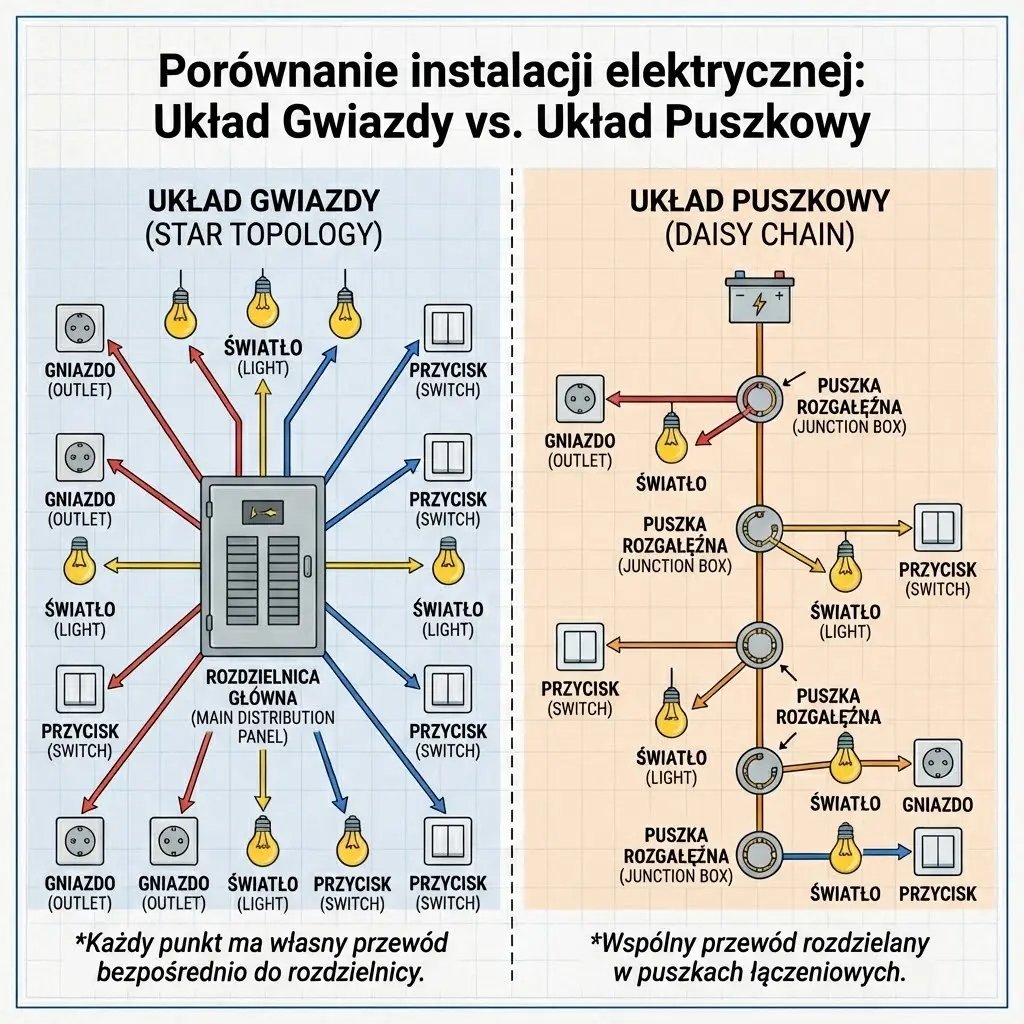
Most problems with Smart Home systems stem from the instability of wireless networks. By choosing a wired installation in a star topology, you gain:
- Reliability: No radio interference or range issues.
- Security: Your data and control don't depend on the manufacturer's cloud or router range.
- Longevity: Copper cables in walls will work just as well in 30 or even 50 years.
- Easy Maintenance: All control points converge in one place – the electrical cabinet.
The Role of boneIO in Your Home
boneIO is not just another closed system. It's the open heart of your installation, connecting the world of professional automation with the flexibility of Open Source software.
Our idea: Create hardware that is as solid as industrial PLC controllers, but at the same time very easy to integrate with the Home Assistant system.
Good Habits and Error Minimization
This documentation is not a controller manual. It's a collection of best practices we've gathered from hundreds of installations. Our goal is to guide you through the construction process so you avoid costly mistakes during design, wiring, and cabinet assembly.
Remember: Start with the design! This is the cheapest stage of construction, yet the most important. Every hour spent on the planning sheet now means ten fewer hours with a drill and chisel in the future.
A well-prepared design is not only your "roadmap" but above all a universal language for communicating with contractors. Whether you're doing the installation yourself or hiring a "traditional" electrician – clear documentation eliminates guesswork, allows for accurate pricing, and ensures the system is built according to your vision, not the installer's habits.