Overview and Specification
Comprehensive guide to the boneIO ESP Cover controller for roller shutters.
boneIO ESP Cover
You can buy the controller -> HERE
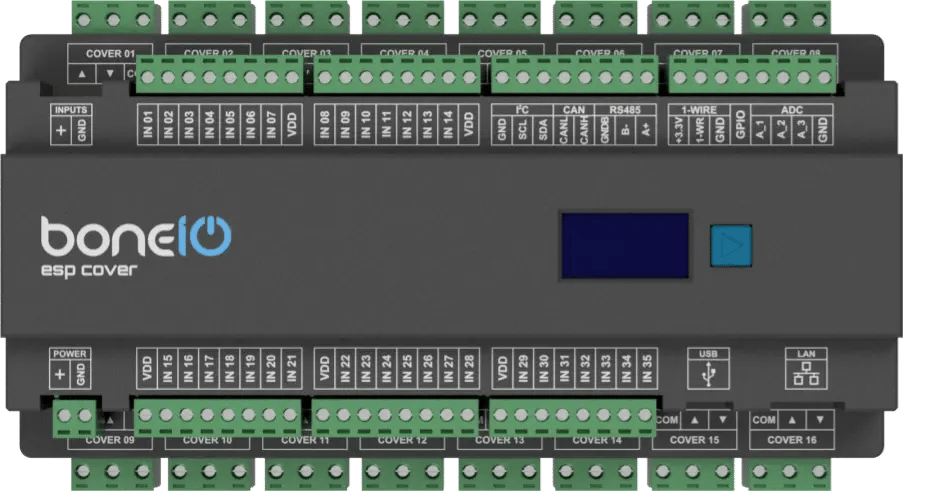
Leveraging the versatile ESP32 microcontroller and the simplicity of ESPHome, the boneIO ESP controller provides an incredibly flexible and easy-to-configure core for your smart home automations.
With 35 digital inputs and 16 cover outputs, a single boneIO ESP controller has enough capacity to manage all the automation in an entire house or apartment.
The boneIO ESP Cover is a specialized controller designed for automating roller shutters, blinds, or gates. It features 32 relays paired with a hardware interlock, allowing for the safe control of up to 16 bidirectional motors. The hardware interlock prevents simultaneous activation of the 'up' and 'down' relays for a single motor, protecting it from damage.
For controlling lights and demanding electrical circuits, we offer other dedicated controllers.
Key Features
- 35 digital inputs for connecting switches, motion sensors, contact sensors and others.
- 32 relay outputs paired for controlling 16 roller shutters.
- Hardware interlock for motor protection.
- 3 analog inputs for integration with analog sensors (e.g., light or wind sensors).
- Reliable network connection via an Ethernet port and USB-C.
- Wide expansion capabilities thanks to Modbus, I2C, CAN and 1-Wire interfaces.
- Built-in OLED screen for a quick overview of the device's status.
- Standard DIN rail mounting (12 modules).
Use Cases
The boneIO Cover model is the perfect choice for:
- Complete automation of roller shutters in single-family homes and large apartments.
- Centralized control of all blinds from a single point or via an app.
- Creating schedules for automatic opening and closing of shutters based on time or sunlight.
- Integration with an alarm system to automatically close all shutters when the alarm is armed.
Technical Specification
| Feature | Value |
|---|---|
| Module | ESP32 |
| Power Supply | 24V DC |
| Power Consumption | 3W - 15W |
| Digital Inputs | 35 |
| Inputs Voltage | 24V DC |
| Relay Outputs | 32 (16 pairs with hardware interlock) |
| Max Output Voltage | 230V AC / 30V DC |
| Max Output Current | 10A |
| Analog Inputs | 3 (A_1 - 0-5V, A_2 - 0-10V, A_3 0-25V) |
| External Interfaces | Modbus RS485, I2C bus, 1-Wire, CAN (for future use) |
| Communication | Ethernet 10/100Mbit, USB-C (for firmware installation) |
| Dimensions (WxHxD) | 216mm x 106mm x 57mm (without plugs) / 216mm x 123mm x 57mm (with plugs) |
| Mounting Width | 12 DIN modules |
| Weight | 800g |
Connectors and Components Description
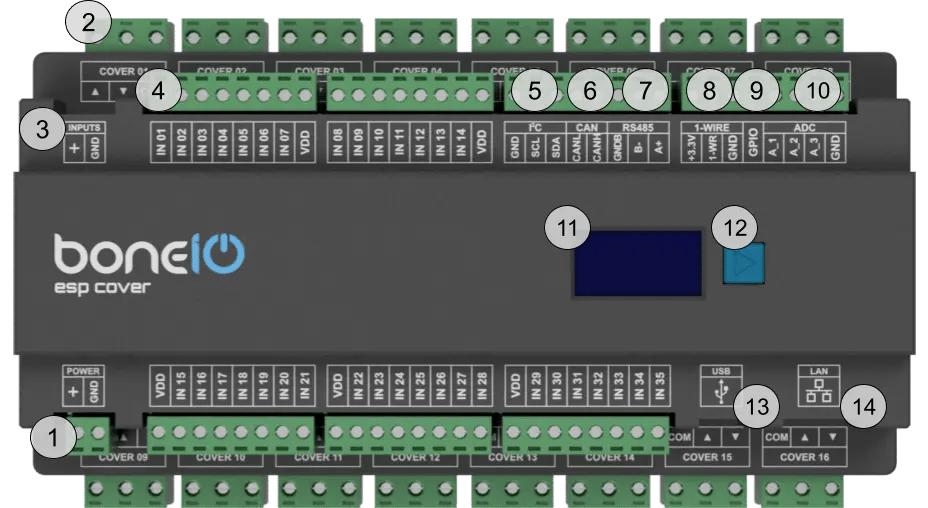
- Power Supply Connector (VCC/GND): Main power supply for the device (24V DC).
- Cover Up/Down Screw Terminals (1-16): Cover outputs, grouped in pairs for cover control.
- Inputs control switch - inputs can be controlled either by + or GND.
- IN Screw Terminals (1-35): Digital inputs.
- I²C bus connector: I²C bus connector for connecting I²C devices.
- CAN bus connector: CAN bus connector for connecting CAN devices. For future use.
- Modbus RS485 connector: Modbus RS485 connector for connecting Modbus devices.
- 1-Wire bus connector: 1-Wire bus connector for connecting 1-Wire devices.
- GPIO connector: GPIO connector for connecting device which can transmit data to ESP32 GPIO. It's pulled down to GND.
- ADC connector: ADC connector for connecting analog sensors to get analog reading of voltage.
- OLED Screen: Displays key information about the device's status, such as IP address, connection status, or CPU load.
- Control Button: Located next to the screen, used to switch between different views on the OLED display.
- USB-C Connector: For connecting to a computer to upload firmware.
- Ethernet Port (RJ45): For connecting to the LAN.
Quick Start Guide
- Device Installation: A qualified person must mount the device on a DIN rail.
- Network Connection: Plug a LAN cable into the RJ45 port.
- Accessing the Web Panel: Find the device's IP address (displayed on the OLED screen or in your router) and enter it into a browser to access the web interface.
- Estimate Shutter Movement Time: Measure the time it takes for the shutter to fully open or close.
- Connect the Shutter: Turn off the shutter's circuit breaker. Connect the shutter motor to the
Cover01 Up/Downoutputs. - Compile and Upload Firmware: Set the estimated movement time in the configuration and upload the new firmware.
- Test the Shutter: Run the shutter from the web panel to verify the configuration.
Certificates
What's Next?
You can find detailed instructions on the dedicated pages. Go ahead and read it!